
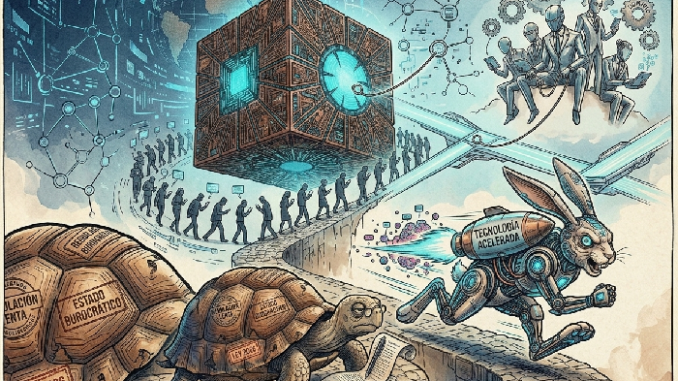
Last Wednesday, August 26, a legal settlement was announced between Meta and a coalition of attorneys general from 29 U.S. states, providing for payments of up to $17.1 billion for damages associated with the use of Facebook and Instagram among children and adolescents, as well as a series of new regulations. However, as we explain in the following essay, the “punishment” and the regulations arrive too late, like a tortoise, in the face of the systemic hyperchanges of an industry that is not only faster than the rabbit, but also has the ability to transform itself and completely change the rules of the game. What can be done in the face of this new paradigm?
By Alexandr Mondragón
There are races in which the tortoise can defeat the rabbit.
Aesop’s fable turned it into a moral lesson: perseverance can defeat speed when the latter becomes arrogant. But the fable belongs to a world where the finish line remains stationary, where the track is the same for both competitors, and where the rabbit, although fast, remains a rabbit.
In the technological world, something different happens.
Here the tortoise is the state, legislation, the courts, institutions, and regulators. The rabbit is innovation.
But the technological rabbit has a characteristic Aesop never imagined: whenever the tortoise begins to catch up, the rabbit can transform into another creature, leap onto another track, and change the rules of the race.
And then what we might call the Law of the Tortoise Chasing the Rabbit of Innovative Disorder emerges.
The tortoise is not necessarily incompetent.
The problem is that it is running after something designed not to remain in the same place.
The Cube That Never Returns to Its Original Position
Imagine a Rubik’s Cube.
Each of its faces appears independent, but it is not. Turning one inevitably alters the others. The player tries to rearrange the colors until reaching a particular configuration.
The Matrixmo Cube (see here and here) works differently.
There is not necessarily a final configuration.
Each technological turn simultaneously alters the other dimensions of the system. An innovation in artificial intelligence changes the economy; the economy changes politics; politics changes information; information transforms social behavior; social behavior generates new economic opportunities; and all of this, in turn, affects technology.
The cube turns.
And when society believes it has found the new equilibrium, another face begins to move.
This is the essential difference between the two cubes.
The Rubik’s Cube has a solution. The Matrixmo Cube has evolution.
That is why regulation faces a structural difficulty: it attempts to order a system whose very mechanism of operation consists precisely in producing new orders out of disorder.
The Swarm: When the Rabbit Multiplies
Here a Science report, published in April 2026, introduces a dimension the fable does not contemplate: the rabbit no longer runs alone.
Advances in generative artificial intelligence and multi-agent architectures have made it possible for swarms of autonomous agents to act in a coordinated, adaptive manner and at a superhuman scale. These swarms can generate persuasive content, exploit psychological biases, simulate artificial consensus, and alter social perceptions with a speed and sophistication that traditional disinformation manuals never achieved.
The tortoise will no longer chase one rabbit.
It will chase a hundred rabbits that communicate with one another, learn from their mistakes, change their appearance, and can be on a hundred different tracks at the same time.
The studies cited in the report —such as the analysis of the Russian IRA’s influence in 2016 or experiments on deepfakes— reveal an uncomfortable truth: human detection of AI-generated content is not significantly better than chance. And AI swarms can coordinate collective actions beyond human capacity, as demonstrated by the work of De Marzo and colleagues on agent coordination.
The rabbit is now a swarm.
And each individual in the swarm can mutate.
The Law of the Advantage of Disorder
From this observation emerges a second proposition: the Law of the Advantage of Disorder.
It could be formulated as follows: In a matrix-based system of power, whoever introduces a disruptive innovation can turn the disorder it causes into the system’s new order, gaining a strategic advantage while other actors attempt to understand, regulate, or adapt to the new conditions.
Disorder, therefore, is not necessarily a failure.
It can be a strategy.
An observer from the outside may perceive chaos. Whoever causes the change may be seeing something else: a reorganization of the board.
And here a decisive question arises.
The innovator does not need to completely control the new order. It is enough to be the first to introduce a variable that forces everyone else to react.
When everyone reacts, the innovator already has the advantage.
The Science report documents this strategy in action: AI swarms do not need to persuade every individual; they only need to flood the information space to generate cynicism, distrust, and epistemic fragmentation. As Pomerantsev and others point out, the strategy is not to convince, but to destabilize shared reality. Disorder is the objective, not the accident.
The Rabbit Does Not Run: It Changes the Track
This is the true difference between the rabbit in the fable and the technological rabbit.
Aesop’s rabbit runs faster.
The Matrixmo rabbit changes the track.
When the tortoise finally manages to catch up with the technology that existed yesterday, it discovers that the race is no longer taking place on the same terrain.
The regulation of social media offers a perfect example.
For years, digital platforms developed mechanisms capable of capturing attention, collecting data, profiling users, and modifying behavior at a speed far beyond institutional response capacity. When investigations, lawsuits, sanctions, and laws began to arrive, the technological architecture had already advanced.
And now the same thing is happening again with artificial intelligence.
While legislators debate how to regulate current models, companies are developing new systems. While the liability of one algorithm is being studied, another appears. While a rule is established for a particular form of content generation, a tool capable of producing it in another way appears.
The Science report adds another layer: AI swarms can adapt in real time during an operation. Muennighoff and colleagues describe test-time scaling methods that allow agents to improve their performance while acting. The tortoise is not merely chasing a moving target; it is chasing a target that learns to evade it while fleeing.
The tortoise finally catches up with the rabbit.
But it finds a burrow.
And inside the burrow, there are a hundred more rabbits.
The Problem of Legislating the Past
There is a disturbing paradox in the relationship between law and technology.
The law needs to define what it wants to regulate. Innovation thrives precisely by creating what has not yet been defined.
That is why legislation usually arrives late.
First comes the product.
Then comes the market.
Then come the users.
Then the side effects appear.
Later, the victims appear.
Finally, the investigations appear.
Then the lawsuits.
Then the legislative hearings.
Finally, the law arrives.
And by then, the product that started it all may have been replaced by another.
The tortoise has arrived.
But the rabbit has already changed species.
The Science report documents how, during Taiwan’s 2024 election campaign, AI-generated disinformation appeared and was countered in real time through verification alliances, but the next generation of tools was already operating in another dimension. Hung and colleagues show that, although Taiwan responded effectively, the technology continued evolving during the response itself.
In the Philippines, professional operators of fake accounts normalized paid “troll work,” creating a manipulation industry that laws cannot manage to dissolve because the very structure of employment and the digital economy has changed.
Meta and the Victory That Contains a Defeat
The agreements recently reached with companies such as Meta (up to $17.1 billion to 29 U.S. states, for deliberately designing features intended to keep minors addicted to social media) may represent important victories. They can force changes in practices, establish protection mechanisms, impose sanctions, and recognize harms that were minimized for years.
But one thing must be understood: a regulatory victory over one technology does not necessarily amount to a victory over the technological process that produced that technology.
That is the danger.
A company may be sanctioned for practices related to social media while the next generation of digital systems is already shifting the battle toward artificial intelligence.
Regulation can close one door.
Innovation may have opened five.
The Science report points out that AI swarms can be used to contaminate future training datasets through the mass seeding of duplicated content, a phenomenon researchers call “LLM grooming.” This means that regulation of current models may be useless if future models have already been poisoned with fabricated narratives. The law closes one door; the swarm has already opened another in the past—or in the future of data training.
That is why the problem is not simply how long the law takes.
It is that the speed of innovation changes the conditions under which the law was conceived.
The Advantage of the First to Create Disorder
Here a geopolitical dimension appears.
Whoever innovates first does not gain merely a commercial advantage. They may gain a political, cultural, military, financial, and even epistemological advantage. The domination of the Mental World-Island, as I anticipated in 2021.
Whoever controls a new technology can influence the rules that will later attempt to regulate it.
It is an extraordinarily sophisticated form of power.
It does not simply consist of controlling an institution.
It consists of creating the conditions to which institutions will have to adapt.
One of the Keys to the Matrixmo Cube
Power then ceases to be exclusively the ability to command.
It becomes the ability to define the environment in which others will have to make decisions.
This is one of the keys to the Matrixmo Cube.
The technological face turns.
The other faces must follow it.
And whoever causes the first turn has, at least temporarily, the privilege of knowing in which direction the cube is turning.
The Science report documents specific cases: in Brazil, during the 2014 elections and the impeachment of Dilma Rousseff, bot-based computational propaganda exploited polarizing issues such as corruption and privatization. Whoever deployed those bots did not need to win the argument; they needed to disrupt the debate so that traditional actors—parties, courts, and the press—would react at their pace.
In Myanmar, the military used Facebook to incite violence against the Rohingya through hundreds of fake accounts posing as celebrities and media outlets. Ethnic disorder was not a byproduct; it was the new order that military power sought to establish, and technology was the instrument used to produce it.
The State Arrives with the Map After the Mountains Have Already Changed
Traditional regulation starts from an understandable premise: first we understand the problem, and then we design the solution.
But disruptive innovation reverses the process.
First comes the transformation.
Then we try to understand it.
And when we finally understand it, it has already produced another transformation.
It is like drawing a map while the territory is moving.
The legislator draws a mountain.
The mountain becomes a valley.
They draw a border.
The border disappears.
They define a category.
Technology creates another.
The tortoise is not merely running slowly.
It is trying to map a territory that changes while it is being mapped.
The Science report adds that the problem is not only that the territory changes, but that the change can be intentional and strategic. AI swarms can generate “synthetic consensus” that simulates majority support for a narrative, altering perceptions of what is normal or acceptable. The tortoise maps the landscape; the swarm is building false mountains for the tortoise to draw.
Does this mean that we should not regulate?
Quite the opposite.
The conclusion cannot be that regulation is useless.
The conclusion is that we need different regulation.
Regulation that does not attempt to predict every future technology, but instead establishes principles capable of surviving technological transformation.
Transparency.
Accountability.
Protection of minors.
Right to privacy.
Independent audits.
Traceability.
Corporate accountability.
Protection against manipulation.
The right to know when a person is interacting with a machine.
And, above all, one essential rule: whoever possesses the ability to produce a massive social impact cannot simultaneously be the sole party responsible for determining the limits of that impact.
Regulation must abandon its obsession with pursuing individual products and begin regulating capabilities and consequences.
Do not ask only: “What does this technology do?”
But also:
“¿Qué poder concentra?”
“¿Qué comportamiento puede modificar?”
“¿Quién controla sus datos?”
“¿Quién se beneficia?”
“¿Quién puede resultar perjudicado?”
And perhaps the most important question: “What new structure of power emerges when this technology is incorporated into the system?”
The Science report suggests concrete avenues: model audits, transparency requirements, labeling of AI-generated content, digital provenance standards, and mechanisms such as Community Notes that harness collective judgment to verify information. But it also warns that these defenses must be proactive, not reactive. “Model immunization”—training AI systems to resist being co-opted—is a biological analogy worth exploring: just as vaccines prepare the immune system, models can be “immunized” against generating harmful content.
The Infinite Race
The tortoise-and-rabbit metaphor thus takes on a different meaning.
The tortoise cannot win a conventional race because the rabbit has a structural advantage: it can modify the conditions of the race.
But the solution is not to turn the tortoise into another rabbit either.
The state should not compete with technology companies in commercial speed.
It must do something different.
It must design the terrain.
Because if the state tries to run after every innovation, it will be condemned to chase the past forever.
But if it establishes rules that are sufficiently general, flexible, and enforceable, it can achieve something much more important: allowing the rabbit to run fast without deciding for itself where the whole of society should run.
The Science report offers a hopeful example: Taiwan combined real-time verification, sanctions against deepfakes, partnerships with civil society and AI developers, and digital education. It did not try to stop technology; it tried to create an ecosystem in which technology could not unilaterally decide the fate of democracy.
The New Order Is Born from Disorder
Here we return to the heart of the Matrixmo Cube.
The disorder produced by innovation is not necessarily accidental.
It can be the initial phase of a reorganization.
A technology alters an equilibrium.
That imbalance forces actors to adapt.
Adaptation produces new institutions, new markets, new behaviors, and new power relationships.
The old order disappears.
And another emerges.
But the actor who caused the first move usually enjoys a decisive advantage: everyone else is still learning the rules of a game that the actor helped create.
That is the rabbit’s secret.
It does not necessarily run faster.
It gets to the future first.
The Science report shows how AI swarms can exploit information dependence—the fact that people receive the same information through multiple pathways, creating a false sense of independent confirmation. This is not a system failure; it is a structural feature that swarms can exploit to create opinion cascades.
Whoever controls the swarm controls the dependency.
Whoever controls the dependency controls the consensus.
And whoever controls the consensus can rewrite the rules of the game.
The Final Paradox
The paradox is that regulation needs stability to function, while innovation needs instability to transform.
The law says: “Let us stop this and establish rules.”
Innovation responds: “I am already somewhere else.”
The law says: “We need to study the consequences.”
Technology responds: “The consequences are already producing new technologies.”
The law says: “We are going to regulate artificial intelligence.”
And the rabbit, somewhere on the next face of the cube, is already building something else.
That is why perhaps the great battle of the 21st century is not between technology and regulation.
It is between those who have the ability to produce the next order.
Because whoever controls the initial disorder can gain an advantage over those who only know how to react to it.
And therein lies the true Law of the Tortoise Chasing the Rabbit of Innovative Disorder: The tortoise can be steady, disciplined, and persistent; it may even catch the rabbit. But if the rabbit has the ability to turn the cube every time it is caught, the race will never be the same.
The tortoise must then stop chasing the rabbit.
It needs to learn to understand the cube.
Because perhaps true power does not consist in running faster than change.
It consists in preventing whoever causes the change from also determining the new order.
The Science report concludes with a warning that resonates with this idea: democracy depends not only on technology, but on the resilience of institutions and the ability of citizens to maintain a shared reality. The tortoise must not become a rabbit; it must become the architect of the terrain.
And perhaps, in that architecture, lie the most enduring defenses against the disorder that others sow in order to harvest power.
Leave a Reply